
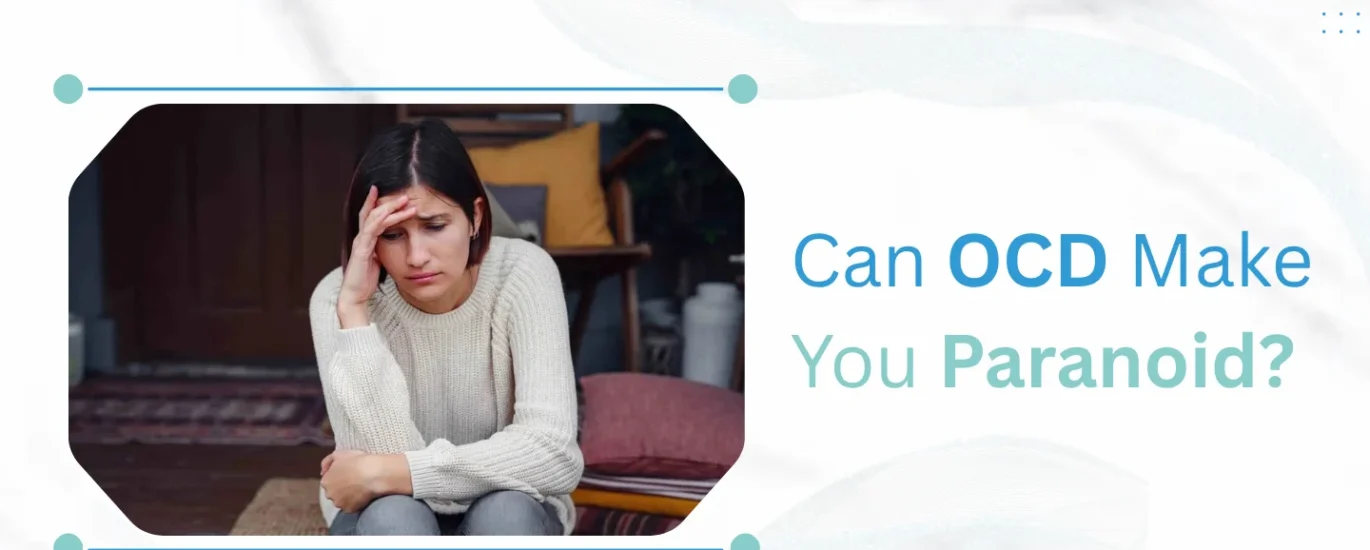
It is incredibly exhausting when your own mind turns against you. You are having your day just now when a scary thought comes out of nowhere. That someone is trying to get you, or that some insidious threat is lurking just around the corner. But with OCD, your brain is already accustomed to being on high alert. But when your intrusive thoughts become a taste, it makes you ask the really scary question: Am I losing my grip on reality? Does OCD make you paranoid?
If you are trying to untangle the connection between paranoia and ocd, please know you are not alone. It is a heavy thing to carry. Let’s talk about how these two mental states actually overlap, what is happening to your nervous system, and how to find your footing again.
The Overlap: Understanding OCD and Paranoia
To understand why your brain is doing this, look at how a hyperactive mind operates. OCD thrives on absolute doubt and a frantic need for safety. Paranoia is a pervasive mistrust of the world or the people in it.
When you sit up at night wondering, can ocd cause paranoia, the answer has some nuance to it. True clinical paranoia – the kind linked to psychosis – is different because a person completely believes the delusion and loses all insight. But ocd and paranoia frequently look like identical twins because OCD can create an experience so intense that it mimics paranoia completely.
In the mental health community, people often call this manifestation paranoid ocd. It’s the exact space where your standard obsessions start feeling like genuine suspicion. You aren’t just worried you forgot to lock the front door; you become consumed by the idea that someone is actively lurking outside to compromise your safety.
How OCD Mimics Paranoia (And Vice Versa)
If you are trying to figure out does ocd cause paranoia, look at how an obsession grows. OCD takes a tiny “what if” and treats it like an absolute guarantee of danger.
Here is how that hyper-vigilance blurs the lines:
- Hyper-Analyzing Hidden Motives: A standard intrusive thought might tell you that a friend is mad at you. A paranoid ocd thought takes it a step further: They are plotting against me. Because OCD demands absolute certainty, you might find yourself dissecting every text message, sideways glance, or email for “proof,” creating a brutal loop of suspicion.
- The Safety Trap: Actual paranoia is that the world is objectively trying to harm you. OCD will say the world is a dangerous place, and that it is literally your job to prevent a disaster from happening. When it is your entire responsibility to safeguard everything, paranoia seems like a normal defensive survival response.
- Fear of Harm or Contamination: For a lot of people, the connection between paranoia and ocdcan ocd cause paranoia shows up in how they protect their physical space. It shifts from a fear of standard germs to a terrifying suspicion that someone is deliberately trying to poison their food or contaminate their home!
When these thoughts are peaking, it feels impossible to separate your reality from your fear. You find yourself completely trapped in a cycle, asking: does ocd make you paranoid, or are you actually unsafe?
Getting out of the Loop
This state of alertness is exhausting and saps your energy. It steals your sleep, peace, relationships, and ability to feel safe in your own body. The truth is that being aware of the strong connection between paranoia and ocd is exactly what we need to do to start getting better.
When your mind spins an apocalyptic narrative about the world, you certainly don’t have to swallow it whole. Now, this is how we move stuff.
- Put a name to it: Name the suspicious thought when it arises. Rather than follow this rabbit hole down the path of, “Why does everyone look at me like that?” If your OCD is very loud right now, try saying to yourself: “My OCD is really, really loud right now and wants me to feel in danger.”
- Calm the body first: Because your nervous system thinks the threat is real, logic won’t work right away. Focus on physical grounding first – deep, slow belly breaths, putting your feet flat on the floor, and letting the panic peak and wash over you without fighting it.
- Dropping the search for proof: The fix for the connection between paranoia and ocd isn’t finding 100% proof that you are safe; it’s learning to sit comfortably with the fact that we can never have absolute certainty about what other people are thinking.
Support at VeVe Health
You don’t have to white-knuckle and fight through a fog-soaked hyper-vigilant mind. We know how tired you are when your mind feels like the most dangerous place to live inside. We practice whole-person modalities that celebrate who you are – acknowledging your unique nervous system, the life you live, and caring about your mental well-being with empathy against altruistic clinical checklists or ratios.
No matter if you’re dealing with thoughts about classic obsessions, running on empty from deep burnout, or facing the scary truth of paranoid ocd we want to create a calm, safe space for you to open it all up.
Right now, your mind may be a very convincing survival game, but you are not broken and must not figure it out alone.
Connect with us at vevehealth.com to schedule a supportive, human conversation. Let’s map out a path to a much quieter mind.