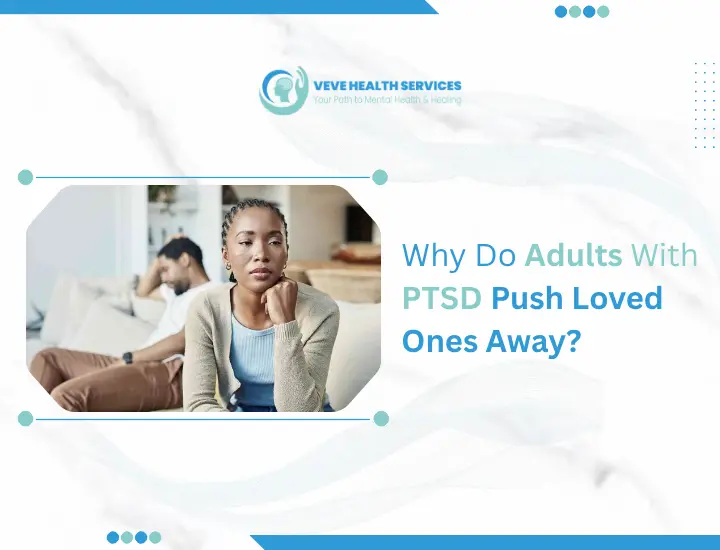
Have you ever had someone you love suddenly pull away from you? Maybe they stop returning your calls. Maybe they seem cold or angry for no reason. Maybe they disappear from your life. If this has happened to you, you might feel confused and hurt. You might wonder what you did wrong.
The truth is, it’s probably not your fault at all! Your loved one may have a condition known as PTSD.
PTSD stands for Post-Traumatic Stress Disorder. It is a mental health condition.
We offer mental health services with compassion at Veve Health Services to help individuals understand their symptoms, manage
emotional issues and develop better relationships.
But why do adults with PTSD push loved ones away? Let’s discuss this.
What Is PTSD?
PTSD develops after someone experiences or witnesses a traumatic event. Trauma may be a result of many things, such as an accident, abuse, natural disaster, or any other frightening event.
Trauma causes the brain to sometimes ‘cling’ to the sense of danger. PTSD can cause feelings of insecurity even while in a calm setting. They may have bad memories that pop into their head without warning. They might feel irritated or anxious at all times.
These symptoms do not resolve without intervention. Sometimes they may persist for several months or several years. And they can make it very hard to be close to other people.
Why Do People with PTSD Push Loved Ones Away?
There are many reasons why a person with PTSD might push you away. None of these reasons mean they do not love you. They have a very hard sickness. Here are the reasons.
They Want to Keep You Safe
This sounds strange, but it is true. Many people with PTSD think they are bad or broken. They think their anger or sadness might hurt you. They may think:
- “I do not want to upset my family.”
- “I do not want them to see me this way.”
They think that if they stay away from you, they will not bother you with their problems. They are trying to be nice. But staying away makes you both feel lonely.
They Feel Empty Inside
PTSD can make a person feel numb. This means they cannot feel happy or loving like they used to. This is not their choice. Their brain shuts down certain feelings to ease the pain.
If they cannot feel love, it is hard to show love. They might seem cold. They might not hug you back. They might not say nice things. This makes you feel rejected. But they are just trying to get through the day. They find it difficult to feel.
They Are Scared of Being Hurt Again
Trauma teaches the brain that the world is not safe. The person learns that bad things can happen at any time. When you get close to someone, you open your heart. That can feel very scary.
For someone with PTSD, being close feels like danger. Their brain says, “You got hurt last time you trusted someone. Do not trust anyone again.” So, they push you away before you can hurt them. It is a way to protect themselves. But it also stops love from coming in.
They Find It Hard to Trust
Trust is very hard for people with PTSD. Often, the trauma was caused by another person. Maybe a parent or a friend hurt them. They learned that people are not safe.
Even if you’re a genuinely good person, they might still have a hard time trusting you. They might fear that you’ll eventually leave or even hurt them, too. This can lead them to keep you at a distance since they don’t want to take that chance.
They Feel Very Ashamed
Many people with PTSD feel shame. They blame themselves for what happened. They think they are weak. They think they are not good enough.
When you feel shame, you do not want anyone to see you. You want to hide. You think that if people see the real you, they will not like you. So, they push you away so you cannot see their shame. They do not think they deserve your love.
Their Feelings Are Too Big
PTSD makes it hard to control feelings. The person might get very angry very fast. They might cry without warning. Little things can make them feel overwhelmed.
When you are with other people, you have to act calm. You have to be nice.
For someone with PTSD, this takes a lot of energy. It is so tiring. Sometimes, being alone is easier.
When they are alone, they do not have to pretend. They can let their big feelings out. So, they stay away from you to have space for their feelings.
Things Remind Them of the Bad Event
We call these things “triggers.” A trigger is anything that reminds the person of the trauma. It could be a sound. It could be a smell. It could be a place.
Sometimes, the people we love can be triggers too.
If the trauma was about a relationship, being close to someone can bring back bad memories. Seeing your face might make them think of the bad time. To stop these bad memories, they stay away from you.
They Are Just Trying to Survive
PTSD takes up all of a person’s energy. They are fighting their own brain every day. They deal with bad memories, bad dreams and lots of fear.
When you are just trying to survive, you do not have energy for anything else. The person with PTSD might forget about everyone else. They are not being mean on purpose. They are just so tired. They are in survival mode. All they can think about is making it through the day.
How This Feels for You
If you love someone with PTSD, this is very hard for you. You try to help, but they push you away. You may feel sad, helpless and angry.
You might think:
- Did I do something wrong?
- Do they still love me?
- Should I stop trying?
These feelings are understandable. Being pushed away by someone you care about hurts.
Don’t forget, this is about their sickness, not you. They push you away not for lack of love but due to illness.
What Can You Do?
If your loved one experiences PTSD, here are some ways to support.
First, let them know you are there. You do not have to talk about the trauma. Just say, “I am here if you need me.” That is enough.
Second, be patient. Healing takes a long time. They may need some distance for now. Just give them space, but don’t disappear. Make sure they know you’re still around.
Third, learn more about PTSD. Read about it. Ask a doctor. The more you learn, the less it affects you.
Fourth, take care of yourself. This is very important. It is hard to help someone else if you are tired and sad. Talk to your friends. Go for a walk. Do things that make you happy. You need to stay strong too.
How PTSD Treatment Can Help Rebuild Relationships
PTSD can be managed in relationships. With proper support, individuals can rebuild trust and reconnect with loved ones. Mental health experts help with understanding trauma and coping skills.
At Veve Health Services, we provide mental health care designed to support individuals facing trauma, emotional challenges and relationship struggles.
We offer many kinds of help. We do psychiatric evaluations. That means we take time to learn about you.
We offer medication management. Sometimes medicine helps the brain calm down. We offer talk therapy such as:
- Cognitive Processing Therapy (CPT)
- Prolonged Exposure Therapy (PE)
- Eye Movement Desensitization and Reprocessing (EMDR)
This helps people work through their trauma.
We also teach about PTSD. When you understand it, it is easier to handle.
We respect your culture and your beliefs. We treat people of all ages. We help with PTSD and more.
When to Get Help for PTSD Symptoms
It is time to get help if PTSD is making life hard. Signs that help is needed include:
- Feeling disconnected from loved ones
- Avoiding relationships or social activities
- Experiencing frequent fear or anxiety
- Having difficulty controlling emotions
- Feeling hopeless or overwhelmed
- Struggling with trust and communication
Asking for help is a positive step.
Final Thoughts
Why do adults with PTSD push loved ones away? Sometimes, adults with PTSD might avoid being close to others because they are trying to protect themselves from painful emotions, fears, or overwhelming feelings.
This behavior usually does not mean they do not care. In many cases, this means that they are experiencing the impact of trauma.
PTSD can be treated and people can learn to reconnect and enjoy healthier relationships with professional treatment and support.
Veve Health Services is dedicated to providing support, healing and hope to those facing the struggles of PTSD and emotional wellness.
For more information, please reach out to us.
FAQs
Can PTSD ruin relationships permanently?
Not necessarily. Many relationships improve significantly with evidence-based treatment, better communication and mutual understanding.
Should I give someone with PTSD space?
Respecting their need for space while remaining consistently supportive is generally more helpful than forcing interaction.